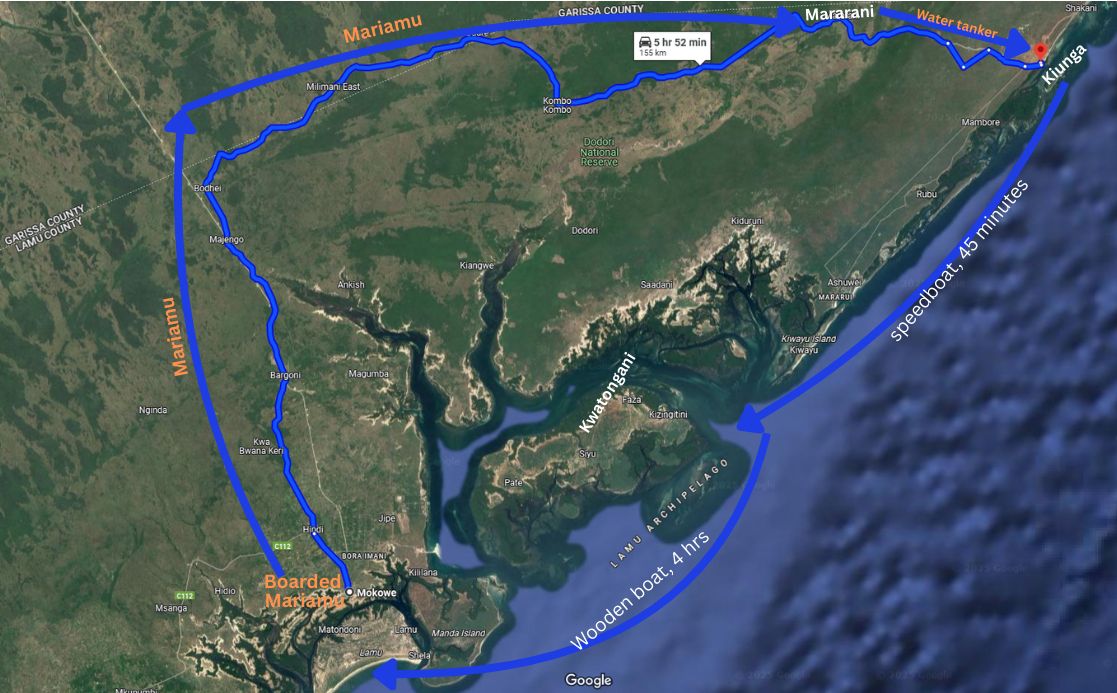
I check the maps now, I laugh at 5hr 52 min, 155 km, back then it felt like endless hours, 1000 km.
Back then, Google Maps wasn’t wisdom, I think. Coz it seems maps were comedy. Five hours? Try a day, maybe two, if Mariamu didn’t skip the week. Distance wasn’t measured in kilometers; it was measured in sandstorms, in shifta whispers at dusk, in the way the road dissolved into wilderness and then into nothingness.
Let’s go back 13 years (pictured map). A journey through the far-flung coastal belt of Kenya, where the Indian Ocean brushes against the then forgotten edges of our country. I can’t make this up. True story; at the time, year 2012, I was a field interviewer working with TNS RMS East Africa, a member of Kantar.
We were three interviewers, and one QC (Quality Control) doing an evaluation survey of the Yes Youth Can Initiative, then funded by USAID. In essence, we assessed the progress of youth bunges; youth-led business groups designed to steer young people away from political violence and toward entrepreneurship. But what we encountered in the Lamu Archipelago was far more than data.
Our hub was in Mombasa, and so we travelled by bus to the far-flung coastal belt of Kenya, where the Indian Ocean brushes against the then forgotten edges of our country. Here, at Mokowe, we boarded a bus named Mariamu. It was the only one that travelled between Mokowe and Kiunga, alternating days like a tide. Miss it on Monday, and you wait until Wednesday. That’s how we began our journey, waiting, hoping, and eventually boarding Mariamu to reach Mararani, a remote village nestled between hardship and hope.
In Mararani, education was in crisis. Pupils in Grade 8 were being taught by a boy who had just completed Grade 8 himself. There were no trained teachers, no one wanted to come work here. The village was too remote, too insecure. Yet, the community adapted. They made do with what they had. It is now a stark reminder of how rural communities stretch the limits of resilience, sharing the little they have, even when the state forgets them.
Despite the insecurity, stories of shifta attacks the night before, of food stolen and lives threatened, the people welcomed us with open arms. One farmer took us to his farm, roasted corn over an open fire, and shared it with us. We laughed, we listened, we connected. In that moment, as I reflect, I see the dignity of rural life, the generosity of people who have nothing but give everything.
From Mararani, we needed to reach Kiunga. With no public transport available, we boarded a water tanker headed to Kisimayu, 27 kilometers from Kiunga. It was a heavily guarded vehicle, rifles on either side, windows shielded with mesh barricades, and a silence that spoke of risk. We were riding through reality, quite literally, to reach the next phase of our work.
In Kiunga, vegetables were a luxury, expensive and scarce, having traveled all the way from Mokowe, Lamu aboard Mariamu. But fish, freshly caught from the nearby Indian Ocean, was abundant and affordable. We feasted on it daily while we worked, a reminder of how geography shapes both scarcity and sustenance.
From Kiunga, we caught a Kenya Wildlife Service (KWS) speedboat to Kwatongani in Faza Island, a 45-minute journey across the Indian Ocean. We spent the night in Kwatongani, and at 5 AM, we boarded a wooden motorboat, slow and heavy, carrying over 85 people and cargo. For four hours, we traversed the Lamu Archipelago, the sea calm but endless, until we reached Lamu Island.
This story is nowhere near its end………………………
This journey, by bus, by water truck, by speedboat, and by wooden boat, was more than a logistical feat. Today, I see it as a metaphor for my life. Back then, I was a young economics undergrad, who later researched whether vegetable farmers could meet their basic needs from farming alone.
That question, from my econ undergrad research, simple yet profound, sparked a deeper inquiry into resource justice. It led me to pursue an MBA in Natural Resources Management, driven by a desire to understand how communities could equitably access and benefit from the resources around them.
Today, I’m pursuing a PhD, applying social marketing and communication to explore community wealth building in the context of water scarcity in Australia’s Murray-Darling Basin. The journey from Mararani to the Murray has been long, uncertain, and at times dangerous, but it has always been purposeful.
This is not just a story about research. It’s about survival, solidarity, and the spirit of communities that thrive against all odds. It’s about young people who choose business over violence, villagers who teach without training, and farmers who share roasted corn with strangers.
It’s about me, and many others, who carry these stories forward, not just in memory, but in action.
But maybe this story isn’t just about me either. Maybe it’s about you.
Maybe you have your own “Mariamu” or a moment, a journey, or a place once ungoable that shaped who you are.
At NARRIVE MEDIA, we believe stories like yours carry weight, wisdom, and the kind of truth that doesn’t shout, but stays. Whether you whisper it anonymously or sign it with pride, the point is: it matters.
So, tell it. Shape it. Share it.
👉🏽 Submit your story here.
Your voice. Your way. Let’s make the ungoable known.

Leave a Reply