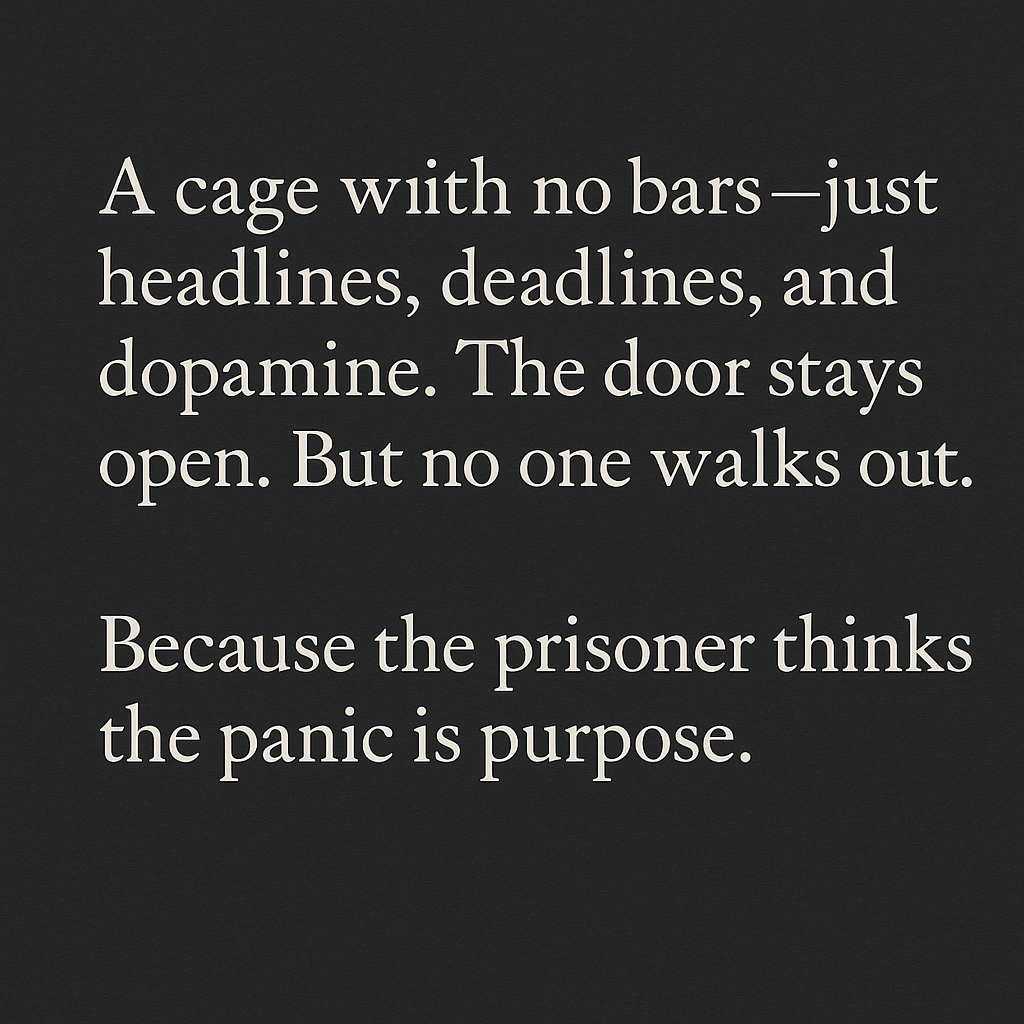
(When intelligence becomes a luxury, and media becomes the master.)
I keep coming back to this idea that intelligence isn’t just something you’re born with — it’s a kind of privilege. Not in the way we usually think about privilege, but in the way it demands time, space, and silence. You need room to breathe, to step back, to make sense of what’s happening around you. But when life traps you in survival mode — paycheck to paycheck, scrolling through curated fear and outrage — you don’t think. You feel. You react. You obey. There’s no luxury for questions, no room for reflection. That’s the mind of a slave. It’s not about chains or prisons. It’s about a mental condition where control is subtle, and obedience is pre-programmed. The media doesn’t just report the news; it prepares you for the news. Softens you, primes you, whispers fear and anticipation into your subconscious long before the story unfolds. So when the hammer drops — when one person is singled out for punishment — you’re already ready. Not shocked, not questioning, just accepting.
And that’s the trap. Because the slave asks, “What did he do wrong?” while the intelligent person asks, “Why now? Who benefits? What are we being prepared for next?” But to ask those questions, you need mental space. You need calm. You need the ability to step outside the moment and see the bigger picture. Yet most don’t have that luxury. They’re caught in the storm — reacting, tweeting, judging, marching, canceling — all for causes that sometimes they haven’t had the time or the clarity to truly understand. And when the truth finally emerges, if it ever does, it barely registers. The next story is already loading. This isn’t journalism. This is psychological conditioning. It’s designed to keep you feeling, never thinking. Feeling outrage, fear, pride, panic — but never the distance or power to analyse what’s really going on.
So, if your mind is shaped more by headlines than by reflection, if your opinions arrive already packaged, and if your emotions are outsourced to influencers and algorithms, then you are not free. You are a slave — not in chains, but in thought. And until you reclaim your ability to ask why, until you fight for the space to question the narratives you’re fed, that mental slavery will remain. It’s subtle, it’s ongoing, and it’s the biggest trap we rarely see coming.

Leave a Reply