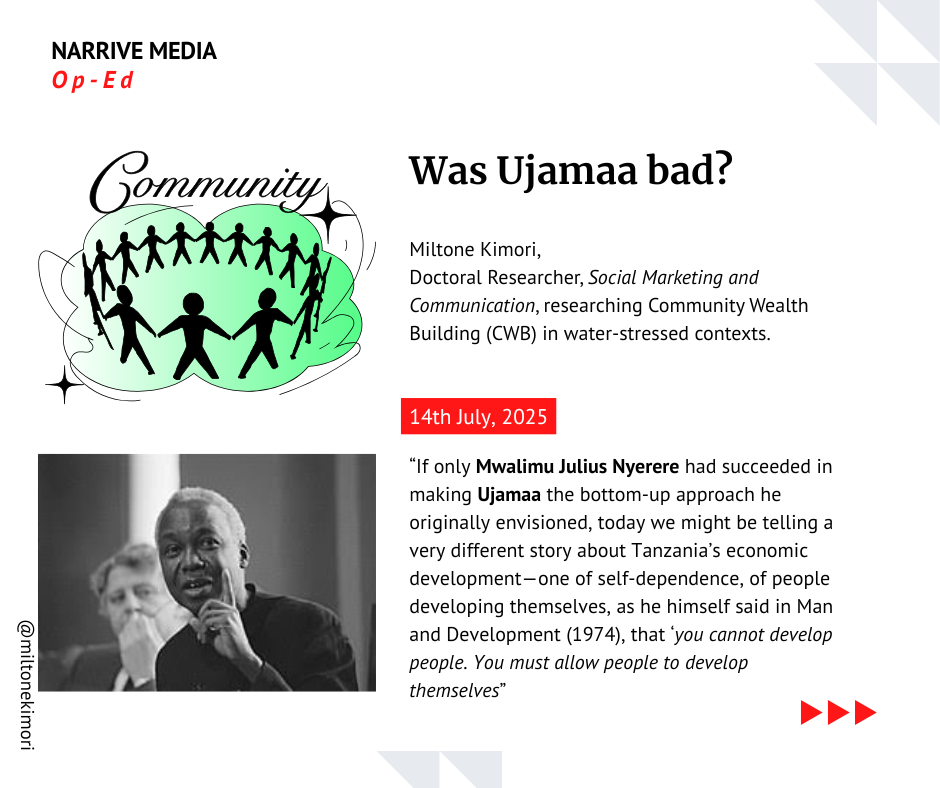
An Op-Ed by Miltone Kimori.
Doctoral Researcher, Social Marketing and Communication, researching Community Wealth Building (CWB) in water-stressed contexts.
Ujamaa, is Tanzania’s bold move towards self-dependence initiated by Mwalimu Julius Kambarage Nyerere in the 1960s, which was intended to promote self-reliance and improve the livelihoods of rural populations through collective farming and communal living. Despite its noble intentions, Ujamaa ultimately failed. According to various historical and academic accounts, Ujamaa’s failure was driven by a combination of internal and external factors, including forced resettlement, inadequate planning, economic mismanagement, and a lack of popular support.[i] This tragic misstep led to decreased agricultural productivity, economic hardship, and widespread resentment among Tanzanians. It is important to note that while I was not alive during this period (I wasn’t even born yet) these conclusions are based on a fair bit of literature review and historical accounts[ii] of that period.[iii]
Key reasons for the failure of Ujamaa
Forced resettlement
The forced resettlement of rural populations into collective Ujamaa villages was said to be a significant factor contributing to the failure of the policy. This process is said to have been rapid and, in some cases, coercive, resulting in a disruption of traditional farming practices that had been well-adapted to local conditions. The relocation also displaced people from their ancestral lands, putting them in areas with less fertile land and poor infrastructure.
According to historical accounts, villagers were not consulted in the decision-making process, leading to resistance. As I read through these historical accounts, I can’t help but ponder; why did Mwalimu (Nyerere) envision such a beautiful idea, which could have led to self-reliance, and then go against the principle itself by being authoritarian about it? It must be noted, that at this point, the term “authoritarian” that I keep seeing as I read stories of Ujamaa, often by non-Tanzanians, itself unsettles me. But that aside, the question I ask now is; Is there something we don’t know?
Most historical accounts I have seen are from non-Tanzanians, as I have pointed out, and thus I can’t help but question whether we truly understand the full story behind Ujamaa. Although, in this interview[iv] with Jonathan Dimbleby of ThamesTv, I see Mwalimu admit, that somehow, the so-called top-down approach was necessary (after all, this is government planning, and governments do plan), and that he felt Ujamaa had to be turned into law for it to work. According to Jaclynn Ashly (2020), while the initial intent was to collectivise rural life, the forced resettlement process alienated many, creating long-lasting social divisions.[v]
Inadequate planning and resources
Another issue is said to be the government’s failure to properly plan for the resettlement of people into these collective villages. According to historical sources, the villages were established in areas that were often unsuitable for agriculture, and there was inadequate provision of resources such as farming tools, water, and housing. With such a lack of support, it is unsurprising that agricultural production faltered.
Based on the analysis presented in Retrospect Journal (2024) by Hector Le Luel, Nyerere’s lack of practical planning meant that the newly created villages had neither the infrastructure nor the agricultural resources needed to support the policy’s ambitious goals.[vi] Why, then, was the policy implemented with such limited resources? Could it be that there were external pressures or limitations Nyerere was facing that we do not fully understand?
Economic mismanagement
Economic mismanagement is also said to have played a significant role in the downfall of Ujamaa. The policy of nationalising industries and emphasising communal farming led to economic stagnation. The communal farming model did not adapt well to Tanzania’s diverse agricultural needs. The lack of incentives for farmers and the inefficiency of state-run enterprises led to a significant decline in agricultural output.
Literature critiques the economic structure that came with Ujamaa, arguing that by centralising economic control, the system stifled innovation and growth. Christopher Graham (2025) explains that the lack of market forces and competition within Ujamaa’s economic system led to inefficiency and a lack of motivation among farmers.[vii] It raises the question: Did the drive for nationalisation and control override the importance of local autonomy in economic decision-making?
Lack of popular support
What becomes clearer to me, as I read more into this period, is that Ujamaa’s failure was worsened by its authoritarian implementation. I ponder, once again: Why did Nyerere, with all his visionary foresight, introduce such a beautiful concept that focused on self-reliance, only to have it undermined by authoritarian methods?
The policy was largely driven by a top-down approach, so I read, with little participation from the very people it was supposed to benefit. In a way, it seems that Nyerere’s vision of self-reliance and collective living was undermined by the coercive nature of its execution. Why would a visionary leader undermine his own idea? Could there have been powers beyond Nyerere’s control that influenced the policy’s downfall?
The lack of popular support, caused by this so-called authoritarian approach, led to resistance and disillusionment among the people. According to Zaki Ergas (2015), the authoritarian implementation of Ujamaa brought about a disconnect between the government and its people.[viii] The forced resettlement, coupled with the authoritarian tendencies of the state, led to widespread dissatisfaction and ultimately disillusionment (Tordoff, 1994).[ix]
Again, as I noted earlier, to me, it seems strange to even use “authoritarian” in the same sentence as Ujamaa, especially when the concept was about communal living and mutual support. Should we even be using such terms in relation to a policy meant to promote social welfare?
External factors
External pressures such as the collapse of global commodity prices, rising oil prices, and drought is thought to have also contributed to the economic decline during the Ujamaa period. However, according to Hayden (2023), these external factors did not solely cause the failure. They certainly worsened the existing issues within Tanzania’s economy, but Hayden (2023) maintains that they cannot be blamed entirely for the decline. The economic policies of Ujamaa were already struggling, and these external shocks acted as a catalyst for their eventual collapse. Also, as noted by Alistair Boddy-Evans (2020), while external factors were significant, the internal weaknesses of Ujamaa were the primary causes of its failure.[x]
But why did Ujamaa fail, really?
Ujamaa’s failure can be understood in terms of the gap between its idealistic goals and the harsh realities of its implementation.[xi] By harsh reality, as a personal opinion, I do not mean ‘forced resettlement,’ no. I believe there were more factors at play here including the fact that at that time, in 1960’s and 70’s, the mechanisms of effectively coordinating over twelve million people were not that efficient as they are today. In any case, I believe it was easier to spread individual than communal interests (especially for those who had the power, of course from support by the culprits we all know; the topplers of self-sustenance and Africa’s independence). I believe these powers were becoming stronger in the early 70’s, and thus the reason why Nyerere felt that it was necessary for it to become law.
Looking closely into Ujamaa villages, there are accounts that indicate these were run democratically. However, in these accounts, it is still clear that individual interests strongly pulled back progress. The policy’s emphasis on communal farming, coupled with inadequate planning and a lack of popular support, ultimately led to economic hardship and a decline in agricultural production (so they say). My question is, why didn’t donors, who came to Nyerere’s rescue, support this idea? Instead, they brought aid with conditionality of facilitating the opposite.
Consequently, the top-down approach, though perhaps well-intentioned, undermined the very principles it sought to promote, leading to frustration and disillusionment among the people (so we hear). But was it really necessary? If Tanzania was truly independent, wasn’t this good idea, then, worth the support by the helping hands (in quotes) that stretched towards Nyerere later in the 1980’s? We will have to go figure this out. After all, Cowen and Shenton[xii] tell us that “development” is really just a way to justify getting involved in other people’s lives. Sounds thoughtful, right? But it’s easy to say that while sitting in an office, far away from the real challenges people face every day.
However, what is clear from the literature, and from my own reading of the period, is that the policy was not inherently “bad.” The failure stemmed from how it was implemented and the external forces that further worsened its shortcomings.
Connecting Ujamaa to contemporary community wealth building (CWB)
As I reflect on Ujamaa, I see a striking parallel with community wealth building (CWB), an approach I am currently researching in my PhD studies. CWB is designed to be a bottom-up process that empowers communities to build wealth from within. However, as is evident in Ujamaa’s experience, even well-intended bottom-up initiatives can face resistance when they are co-opted by top-down forces. Despite the grassroots nature of CWB, neoliberal policies often impose themselves on these local efforts, challenging their potential. This paradox is central to my research, as CWB faces both opportunities and challenges in navigating the growing tensions between local autonomy and external interventions.
In many cases, the powerful forces of neoliberalism overpower these community-driven efforts, leading to a situation where good ideas, such as those put forth by Nyerere, are toppled by top-down interventions, often labelling ideas such as those by Nyerere as “nationalist,” “radicalistic,” or “anti-globalisation.” These labels serve to delegitimise local, community-driven development in favour of global market-based solutions. This dynamic leads to the very kind of resistance we see in Ujamaa’s legacy today, where the disconnect between grassroots development and external, neoliberal frameworks continues to slow progress.
Risk of rejection in academia (it might not be, pay attention)
This op-ed, by critically analysing Ujamaa and its failure in light of contemporary CWB principles, brings me yet to another precarious situation within academia. Many of us scholars are entrenched in neoliberal development models (don’t pretend otherwise, publishing, ring a bell?), and questioning these paradigms often leads to rejection. In our own spaces, when we interrogate history, and see the light, and then start advocating for community-driven solutions, like Ujamaa, that run counter to neoliberalism, we often risk being labelled as “too ideological” or “too radical” within the academic community. (Ever heard of ‘powers to read and write (wright)?’ do we really have these powers?). But this is the essence of academic inquiry, challenging established norms and questioning why certain policies succeed or fail. Ujamaa’s failure, due to both internal mismanagement and external neoliberal pressures, serves as a cautionary tale that we must learn from as we continue to explore community-led, asset-based development.
This tension between theory and lived experience is not new. In reflecting on the implementation of Ujamaa, it becomes clear that much of the dominant narrative, shaped by academic and policy-driven analyses, has failed to capture the realities of Tanzanians on the ground. Scholars like Michael Cowen and Robert W. Shenton, in their Doctrines of Development, offer a sharp critique of development as a doctrine that legitimises intervention from above. Ironically, however, their own work remains largely confined to the analysis of political machinery and official documents,[xiii] rarely engaging with the grassroots[xiv] where development is actually lived. This contradiction mirrors the very academic detachment I critique above. It also reinforces why, in my own work, I must resist the temptation to theorise from a distance.
Therefore, in my own research, and within myself, by learning from history, further escaping the criticism faced by Michael Cowen and Robert Shenton in their Doctrines of Development,[xv] and other development theorists and scholars who have faced similar criticisms, I intend to work with communities, being deeply involved in the grassroots, and experiencing what they experience in their daily lives. If all goes well, with ethical approvals, I will start from up [laughable, very laughable] (analysing documents without ignoring political machinery) to the bottom, learning with communities, without ignoring theoretical frameworks, that will cement my position as a researcher, and not only a academic.
[i] ThamesTv, “Julius Nyerere Interview | Tanzania | This Week | 1977,” YouTube, October 14, 2017, https://www.youtube.com/watch?v=1t9gJd9p5ZM.
[ii] AfroMarxist, “Tanzania: Progress through Self-Reliance (1969),” YouTube, September 6, 2018, https://www.youtube.com/watch?v=8IYbv0bW43w
[iii] MIGAVISION, “Film: ‘UJAMAA AFRICA, the Great Dream of Julius NYERERE in Tanzania.,’” YouTube, February 1, 2023, https://www.youtube.com/watch?v=LHkhbS29SiY
[iv] ThamesTv, “Julius Nyerere Interview https://www.youtube.com/watch?v=1t9gJd9p5ZM.
[v] Jaclynn Ashly, “Tanzania: Remembering Ujamaa, the Good, the Bad and the Buried,” African Arguments, December 17, 2020, https://africanarguments.org/2020/12/tanzania-remembering-ujamaa-the-good-the-bad-and-the-buried/.
[vi] Hector Le Luel, “Legacies of Ujamaa,” Retrospect Journal, October 27, 2024, https://retrospectjournal.com/2024/10/27/hector-le-luel-legacies-of-ujamaa/.
[vii] Christopher C Graham, “From Ideologies to Practice: A Political Ecology Approach to Green Transitions – the Case of Tanzania’s Ujamaa Sustainability Communities,” World Development Sustainability 6, no. June 2025 (March 1, 2025): 100217–17, https://doi.org/10.1016/j.wds.2025.100217.
[viii] Zaki Ergas, “Why Did the Ujamaa Village Policy Fail? – towards a Global Analysis,” The Journal of Modern African Studies 18, no. 3 (September 1980): 387–410, https://doi.org/10.1017/s0022278x00011575.
[ix] William Tordoff, Government and Politics in Africa (Bloomington: Indiana University Press, 2002).
[x] Alistair Boddy-Evans, “What Was Ujamaa and How Did It Affect Tanzania?” ThoughtCo, 2019, https://www.thoughtco.com/what-was-ujamaa-44589.
[xi] Goran Hyden, Beyond Ujamaa in Tanzania: Underdevelopment and an Uncaptured Peasantry (University of California Press, 2023).
[xii] Michael Cowen and Robert W Shenton, Doctrines of Development (London; New York: Routledge, 1996).
[xiii] Bernstein, Henry. “The Antinomies of Development Studies.” Journal Für Entwicklungspolitik, n.d. doi:10.20446/JEP-2414-3197-23-2-12.
[xiv] Staudt, Kathleen. “Doctrines of Development by M. P. Cowen and R. W. Shenton (Book Review).” The Journal of Developing Areas. 31 (n.d.).
[xv] Ibid.

Leave a Reply